Credible Roots / Field Notes / Google knowledge panel
Reference
Google knowledge panels: how they actually appear
No form, no paid route, no timeline anyone can commit to. What a panel really is, how it differs from a Wikipedia article, and the five things that genuinely move it.

More than five years in personal branding. Runs atharvsankpal.com and works with founders and businesses in the US on their digital presence. Previously produced AI video for brands.
Published 2026-08-14
Researched against primary sources, drafted with AI assistance, then reviewed and approved by the named author. How we write · About the author
The short answer
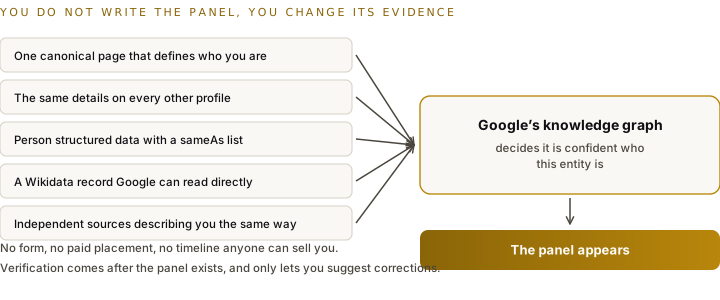
A knowledge panel is generated automatically when Google's knowledge graph becomes confident it knows who an entity is. There is no submission form, no paid placement and no timeline you can buy, so every lever available to you is indirect. What moves it is making your identity unambiguous: one canonical page that defines who you are, consistent details across every other profile, Person structured data with a sameAs list tying those profiles together, a Wikidata record Google can read directly, and a growing set of independent sources describing you the same way. Once a panel exists, the person it represents can verify themselves and suggest corrections — useful for fixing errors, and not editorial control.
- No submission process exists. Anyone selling you a panel is selling nothing.
- Consistency is the lever. One canonical bio, matching details everywhere else.
- Corroboration comes from sources you do not control, which is the slow part.
- Claiming is not control. Verification lets you suggest, not write.
On this page
What a panel actually is
The box beside search results for a person is not a profile you own. It is Google's summary of an entity in its knowledge graph, assembled from many sources at once: the open web, structured data, licensed datasets and public reference sources.
That design has one consequence worth internalising. Because the panel is a conclusion Google draws rather than a document you file, everything you do to influence it is indirect. You are not writing the panel. You are changing the evidence it is drawn from.
Panel or Wikipedia article
These look like the same prize and get treated as one. They are separate systems, run by different organizations, under different rules.
| Wikipedia article | Google knowledge panel | |
|---|---|---|
| Who controls it | Volunteer editors | Google's knowledge graph |
| The bar | A formal notability standard | Entity confidence, lower and less formal |
| How it is created | Written and reviewed by people | Generated automatically |
| Your involvement | Disclosed, and no control of the result | Verification lets you suggest corrections |
| Usually arrives | Later, and for a minority | Earlier, and more often |
They feed each other, which is why they get confused: panels often draw their description from Wikipedia. But you can hold either without the other, an article can be deleted while a panel persists, and both sit downstream of the same thing — a body of independent material about you, in places you do not own.
The five things that move it
- One canonical page. A single definitive page that states who you are, what you do and where. Everything else points at it.
- Consistency everywhere else. Same name form, same title, same organization, same biography across every profile. Contradiction is the most common reason an entity stays unresolved.
- Person structured data with sameAs. Machine-readable markup on your canonical page that lists your other profiles, so a crawler does not have to infer that they are the same person.
- A referenced Wikidata item where you meet the criteria — read directly by the knowledge graph. How that works.
- Independent sources describing you the same way. The slow one, and the only one you cannot do in a week. It is also the reason this site is mostly about distribution.
What nobody can sell you
There is no application, no expedite, no partner program and no verified timeline. If a provider quotes you a date for a personal knowledge panel, they are quoting a number they have no mechanism to deliver.
What claiming does get you, once a panel exists: verification through Google, the ability to suggest corrections, and a say in the featured image. Useful when a panel has your employer wrong. Not the same as writing it.
How we run this
Three stages, and the first one often ends the conversation honestly.
- Entity audit. We search you the way Google does and map what exists: every profile, byline, mention and listing, and every place where your title, employer or biography contradicts another source.
- Resolve the contradictions. Canonical page, structured data, sameAs, consistent details, Wikidata where the references support it.
- Feed the corroboration. Which is distribution work, not knowledge-panel work, and it runs for months.
For individuals rather than businesses, this takes considerably longer than people expect. We would rather say that at the start.
Questions people actually ask
Can I apply for a Google knowledge panel?
No. There is no submission form and no paid route. Every available lever is indirect.
Do I need a Wikipedia article to get a panel?
No. It is a strong corroborating signal where you qualify, but plenty of people hold panels without one.
What does claiming a panel actually let me do?
Suggest corrections and choose a featured image. Google decides what to accept.
How long does a personal knowledge panel take?
For individuals, usually many months, and it depends on corroboration you do not control.
Sources
- Google. About knowledge panels — how the information is sourced.
- Google. Get verified and claim a knowledge panel.
- Schema.org. Person type and the sameAs property.
- Wikidata. Notability policy.
How this was made: researched against the primary guidelines rather than summaries of them, drafted with AI assistance, then reviewed and approved by the named author before publication. This page replaces three shorter pages that covered the same ground separately; the merge is logged on our corrections page. Our editorial standards.
Related reading
- Wikidata — the structured layer the knowledge graph reads.
- Wikipedia notability — the other system people confuse this with.
- How this actually ends up at Wikipedia
- How to get cited by AI search
- Entity resolution as part of the SEO work
- Entity resolution, as a service
Start with the entity audit
We will show you what Google currently thinks you are, and where the contradictions sit. That part is quick and it is usually the surprise.
Book a 30 minute call