Credible Roots / How this ends up at Wikipedia
The long game
How this actually ends up at Wikipedia
Wikipedia is the last link in a chain that starts about two years earlier, with distribution. Here is the whole chain, the honest timeline for each stage, and why we will not touch Wikipedia in your first year.

More than five years in personal branding. Runs atharvsankpal.com and works with founders and businesses in the US on their digital presence. Previously produced AI video for brands.
Published 2026-08-14
Researched against primary sources, drafted with AI assistance, then reviewed and approved by the named author. How we write · About the author
The short answer
A Wikipedia article summarizes independent coverage that already exists. Independent coverage happens to people whose excellence is visible, and excellence becomes visible through distribution: publishing consistently, in the formats your industry actually reads and watches, until you are the person in your field with a body of public work. That produces an audience, then invitations, then the features and podcast appearances that constitute a real public record — and only then is there anything for an encyclopedia article to summarize. So we start at the front of that chain, not the back. For most clients we do not go near Wikipedia in the first year, because there would be nothing to submit.
- The chain runs one way. Distribution → visible excellence → coverage → eligibility.
- Wikipedia is a lagging indicator, not a service you buy.
- Everything before the last link is worth having on its own.
- If your coverage is thin today, a Wikipedia engagement now is the wrong purchase.
On this page
The chain, in order
Most of this market sells the last box and hopes you do not ask about the first four.
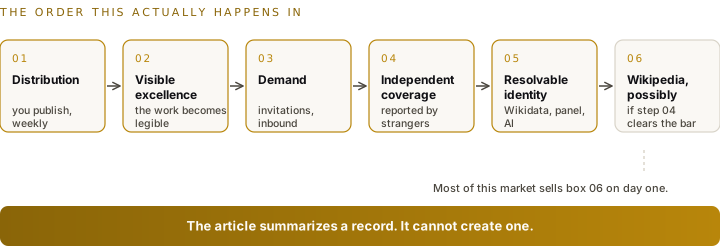
- 01 — Distribution. You publish. LinkedIn posts in your own voice, video that people in your industry actually watch, a site that holds your thinking rather than your CV. An hour a week, sustained, beats a campaign.
- 02 — Visible excellence. The work you were already doing becomes legible to people who have never met you. This is the step that cannot be shortcut, and the step where most people quit.
- 03 — Demand. Inbound conversations, speaking requests, podcast invitations. Journalists start finding you rather than being pitched.
- 04 — Independent coverage. Features, profiles, reported pieces written by people with no relationship to you. This is the raw material for everything downstream.
- 05 — A resolvable identity. Structured data, a Wikidata record, a knowledge panel, citations in AI answers — because the coverage now exists for those systems to resolve you against.
- 06 — Wikipedia, possibly. If the coverage in step four clears the notability bar, an article becomes defensible. If it does not, no vendor can change that.
Why the order matters commercially
Anyone can sell you step six on day one. It will fail at review, and you will have paid for the failure. The reason we lead with Wikipedia on the homepage is that it is the outcome people recognize — not the service we start with.
Why we skip Wikipedia in year one
Plainly: in the first year of most engagements we do not touch Wikipedia at all.
Not as a policy for its own sake. It is arithmetic. An article needs several substantial, independent, in-depth pieces written by people unconnected to you. If you have none today, the fastest honest route to having some is twelve months of publishing and the coverage that follows — not a draft submitted early and declined, which costs you the fee and leaves a rejected draft in the record.
What we do instead in that year is the work that produces the sources: the publishing engine, the video, the site, the structured identity underneath it. Wikipedia becomes a live question when the coverage makes it one, and we will tell you when that is.
Five different clocks
These run at genuinely different speeds, and treating them as one project is the most common planning error.
| Layer | Realistic timeline | What it depends on |
|---|---|---|
| Published work | First month | Your willingness to give an hour a week |
| Wikidata record | Weeks | Whether serious public references exist |
| Earned coverage and invitations | Quarters | A body of public work worth noticing |
| Knowledge panel | Many months | Accumulated corroboration across sources |
| Wikipedia article | Years, if ever | Whether independent coverage clears the bar |
Because the slow layers depend on evidence accumulating, starting earlier matters more here than in most marketing. The compounding is real and it is not fast.
How this differs from PR
They are complementary, and they fail at different things.
| PR | Distribution | |
|---|---|---|
| The job | Get journalists to write about you now | Build public work that makes you worth writing about |
| Depends on | A story worth telling this quarter | Consistency over quarters |
| Timeline | Campaign shaped, weeks to months | Compounding, months to years |
| Shelf life | A news cycle | Everything published stays published |
| Cannot do | Manufacture substance you do not have | Force a journalist to write this month |
If you have a genuine story to pitch today, PR is the faster instrument and we will say so. What PR cannot do is manufacture notability out of nothing, which is why so many Wikipedia attempts that follow a press push still fail.
Reach and record are different assets
Followers are not credibility, and credibility is not reach. Both are worth having, they compound in different directions, and only one survives you leaving a platform.
| Reach | Public record | |
|---|---|---|
| Produces | Audience and attention | Credibility that can be checked |
| Lives on | Platforms you do not own | Sources you do not control |
| Measured by | Followers, impressions, engagement | Whether search and AI resolve you correctly |
| Speed | Fast, if you post consistently | Slow, and durable once built |
The reason to care about the second column: follower counts are invisible to the systems a journalist, a board or an answer engine consults. Those systems resolve entities and cite sources.
When this is the wrong purchase
Some honest disqualifiers, because they save everyone time.
- You want the Wikipedia article and nothing else. We cannot sell that, and the people who will are selling you a decline.
- You have no appetite to publish. An hour a week of your actual thinking is the input. Without it there is nothing to distribute.
- You need results this quarter. Wrong instrument. Paid acquisition or PR will serve you better.
- Your expertise is genuinely thin. Distribution makes excellence visible. It does not manufacture it, and it makes the absence visible too.
Questions people actually ask
Do you work on Wikipedia straight away?
No — for most clients, not in the first year. There would be nothing to submit. The useful work is upstream.
Is this PR?
No. PR gets journalists to write about you now; distribution builds the body of work that makes you worth writing about, and it keeps producing after a campaign ends.
What if I never become notable enough for Wikipedia?
Likely, for most people, and the work is not wasted. Audience, inbound, coverage and a resolvable identity are worth having on their own.
How quickly does anything show up?
Published work in month one. Wikidata in weeks. Coverage in quarters. Knowledge panels in many months. Wikipedia in years, if ever.
Sources
- Wikipedia. General notability guideline (WP:GNG) — the standard the last link in the chain is judged against.
- Wikimedia Foundation. Terms of Use, section 4, paid contributions disclosure.
- Google. About knowledge panels — on entity sourcing and why corroboration is the slow part.
- Timelines on this page are practitioner reports from our own engagements, not published research, and are labelled as such.
How this was made: written from the work we do for clients and from the guidelines and research linked on this page, drafted with AI assistance, then reviewed and approved by the named author before publication. Our editorial standards.
Related reading
- Distribution — the front of the chain, and most of what we actually do.
- What distribution actually gets you
- Wikipedia notability — the bar at the far end.
- What a Wikipedia page actually costs
Start at the front of the chain
The first call is an honest read on where you are in the sequence, and what the next twelve months would actually look like.
Book a 30 minute call