Credible Roots / Field Notes / Wikipedia notability
Reference
Wikipedia notability, and the route that applies to you
The bar in plain English, what counts as a source and what never does, the specialist routes for academics, authors, clinicians and lawyers, and the reason accomplished professionals get turned down.

More than five years in personal branding. Runs atharvsankpal.com and works with founders and businesses in the US on their digital presence. Previously produced AI video for brands.
Published 2026-08-14
Researched against primary sources, drafted with AI assistance, then reviewed and approved by the named author. How we write · About the author
The short answer
Notability means significant coverage in reliable sources that are independent of the subject. Those are three separate tests and one source has to pass all three to count. It is not fame, revenue, seniority or years in the field. Some professions have a second door — academics are judged on disciplinary impact rather than press, authors on critical attention to their work — but none of those routes lowers the sourcing requirement, they change what counts as a source. And none of it can be bought: an article exists because independent people already wrote about you at length, and volunteer editors agreed that record clears the bar.
- Three tests, one source. Significant, reliable, independent — all true of the same piece.
- Your own material never counts. Your site, your company's announcements, your contributed columns.
- Volume is not depth. Fifty mentions do not equal two proper profiles.
- The specialist routes are real and they are narrower than they sound.
On this page
Why the article cannot be bought
The premise of most services in this category is that the article is the product. It is not. The article is a byproduct of a record that already exists somewhere else.
Wikipedia is a tertiary source. It summarizes what independent, reliable publications have already published about a subject. If those publications have not written about you in any depth, there is nothing for an article to summarize, and no amount of skilled drafting changes that. This is why articles about genuinely accomplished people are deleted every week: the person is excellent at their work, and their public record consists of their own website, their company's announcements, a handful of interviews and some bylined columns. None of that counts.
So the honest sequence runs backwards from how it is usually sold. Coverage first. Article second, if the coverage earns it. Everything on this site about distribution exists because of that ordering — the chain that actually leads here starts about two years earlier than most people expect.
Worth knowing
Wikipedia's conflict of interest guideline states that paid offers guaranteeing an article will be kept from deletion are always fraudulent. If someone guarantees the outcome, that is the end of the conversation.
The rule in plain English
The general notability guideline says a subject is presumed to merit an article when it has received significant coverage in reliable sources that are independent of the subject.
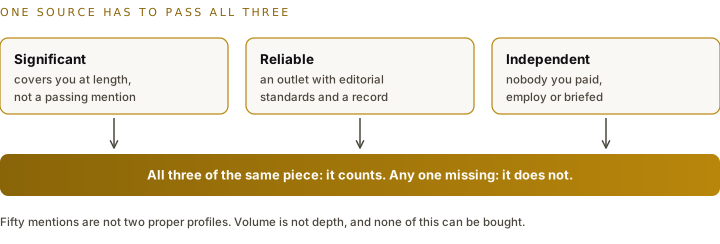
Read that as three tests applied to every source you want to rely on. Does it cover the person directly and in detail? Does it come from a publication with genuine editorial standards? Was it produced by someone with no connection to the person? A source must pass all three. Most sources professionals are proud of pass one or two.
The word presumed matters too. Meeting the bar makes an article defensible, not automatic. Reviewers still weigh whether there is enough substance to write something encyclopedic rather than promotional.
What counts as a source
This is the whole game, so it is worth being concrete.
| Source | Counts | Why |
|---|---|---|
| In-depth profile in an established newspaper or magazine | Yes | Independent, edited, covers you directly |
| Peer reviewed research about your work | Yes | Independent and reliable; strong for academics |
| A book from a proper publisher discussing you | Yes | Independent, with editorial oversight |
| Reviews of your books in edited publications | Yes | Critical attention to the work counts for creative professionals |
| Reported trade press coverage | Often | Depends on the outlet's editorial standards |
| Straight question-and-answer interview | Rarely | A primary source for your own statements |
| Press release or company announcement | No | Not independent |
| Contributed column under your byline | No | Your words, not coverage of you |
| Your website, bio page or company blog | No | Self-published |
| Paid award, sponsored list, placed feature | No | Not independent, and reviewers know the formats |
| Passing mention or quote in a wider story | No | Not significant coverage of you |
| Directory rankings and firm tiers | No | Not independent editorial coverage of you |
A useful test before you spend anything: open a document, paste in the links you would put forward, and delete every one that fails any of the three tests. What is left is your actual case. Most people are surprised by how short that document is, and finding that out costs nothing.
The route that applies to you
The general standard is the default. Several professions have a second door, and which one you are being judged against changes the assessment completely. This section replaces the five separate profession pages this site used to run, because the honest version of each was a section rather than an article.
Founders and executives
No specialist route exists, so the general bar applies without shortcuts: several substantial pieces, in publications with real editorial standards, written by people unconnected to you. The specific trap is that a founder's record is usually made of things the company generated — funding announcements, product launches, the newsroom, entered awards, podcast appearances. All of it traces back to you, so none of it counts. Coverage of your company is also not coverage of you: a profile of the business that quotes you makes the business potentially notable, not you.
Academics and researchers
The academic criteria are unusual in two ways. They do not ask for press: a scholar with no media profile can qualify on citation record, election to a highly selective scholarly society, a named or distinguished chair, or a major academic award. And verification can rest on primary sources, so a university's own announcement of a chair is acceptable evidence of the chair. That is a genuine departure from how the rest of Wikipedia's sourcing works. What has not changed is the height of the bar: the standard is explicitly that you are substantially more accomplished than the average professor in your field, with citation practice judged against discipline norms rather than a universal number.
Authors and writers
The criteria for creative professionals run alongside the general standard rather than replacing it. The most useful for a working writer: a person may qualify by having created a significant body of work that has been the subject of multiple independent reviews or critical attention. The coverage does not have to be about you. Reviews of your books, in publications with genuine editorial standards, can carry it even if no journalist has ever profiled you. Other routes include originating a significant concept and holding work in permanent collections. Self-published output with no independent critical reception does not qualify, and reader reviews on retail sites are not editorially reviewed sources.
Doctors and surgeons
Clinicians usually arrive through one of two doors. Research-led clinicians are assessed under the academic criteria, where citation impact, fellowships, chairs or major awards can carry it without press. Practice-led clinicians face the general standard in full. Clinical reputation, patient outcomes, procedure volume and peer regard are not criteria, however substantial they are — peer regard is not a source. Medicine also attracts closer sourcing scrutiny than most subjects, so claims about treatments and outcomes are held to a higher evidentiary standard and promotional framing is removed quickly.
Lawyers
No dedicated guideline, so the general standard applies. In practice the coverage tends to arise from three places: involvement in cases that themselves attracted substantial independent reporting, where journalists wrote about your role rather than listing you as counsel; legal scholarship with genuine academic impact, in which case the academic criteria may apply instead; or judicial and senior public appointments, which carry their own weight. Firm rankings, directory listings, awards the firm submitted for and practice-area profiles do not establish notability, however familiar they are inside the profession.
The pattern
Every specialist route swaps what counts as evidence. None of them lowers the requirement that the evidence be independent of you. If a route seems to let your own material in, you have misread it.
Why good professionals get declined
Across the assessments we run, the reasons cluster tightly, and almost none of them are about writing.
- The record is self-generated. Impressive in volume, and every item traces back to the subject or their organization.
- Company coverage is mistaken for personal coverage. The most common single error, and the hardest to hear.
- Volume is mistaken for depth. Dozens of mentions, no piece that treats the person as its subject.
- Output is mistaken for impact. Particularly among academics: a long publication list is not a citation record.
- Tone. A defensible case written promotionally gets rewritten or removed. This one is fixable; the others are not fixable by drafting.
Formatting and structure account for a minority of failures. The single largest cause is that the sources do not establish notability, and that question can be answered before a word is drafted — which is why we answer it first, and for free.
The rules when someone is paid
You are allowed to write about yourself, and the community strongly discourages it: the autobiography guidance is blunt that writing about yourself is difficult to do neutrally, and conflict of interest applies to you as much as to a paid editor. The recommended route for anyone connected to the subject is the same either way — submit through Articles for Creation rather than publishing directly, and declare the connection.
If money changes hands, the Wikimedia Terms of Use require the contributor to disclose employer, client and affiliation. That is not a courtesy; undisclosed paid editing is the fastest route to a blocked account and a deleted article.
| Doing it yourself | Paying someone | |
|---|---|---|
| Cost | Free, plus your time | A fee, and fees vary enormously |
| Notability judgment | Yours — and self-assessment is the hardest kind | Should be independent, if the provider is honest |
| Source research | The real work, and it is slow | The bulk of what you are buying |
| Disclosure | Declare the connection, submit through review | Employer, client and affiliation, under the Terms of Use |
| Control of the result | None | None |
If you are clearly notable, comfortable reading guidelines carefully and willing to accept an outcome you cannot control, doing it yourself is a legitimate option that costs nothing but time. What a provider is actually selling is the assessment, the source research, and having been through review before. What that costs, and what the prices in this market mean.
Questions people actually ask
Can I pay to have a Wikipedia article created about me?
You can pay someone to assess your coverage, draft an article and submit it with the paid relationship disclosed. You cannot pay for the outcome. Volunteer reviewers decide whether it stays, and Wikipedia's own guidance treats paid guarantees against deletion as fraudulent.
Does being a successful founder make me notable?
Not by itself. Founders have no specialist route, and most of a founder's record traces back to the company. Coverage of a company is not coverage of its founder.
Why do academics qualify without any press coverage?
Because the academic criteria ask about disciplinary impact rather than media attention, and allow the underlying facts — a chair, a fellowship, a citation record — to be verified from primary sources.
How long does review take?
Once a draft is submitted through Articles for Creation, a few weeks to a couple of months depending on backlog. That clock only starts if the coverage supports a submission at all, which is the part measured in years.
Sources
- Wikipedia. General notability guideline (WP:GNG).
- Wikipedia. Notability guideline for people (WP:BIO), including the creative-professionals criteria.
- Wikipedia. Notability guideline for academics (WP:NACADEMIC).
- Wikipedia. Identifying reliable sources (WP:RS).
- Wikipedia. Conflict of interest guideline (WP:COI), including autobiography and fraudulent guarantees.
- Wikipedia. Paid-contribution disclosure policy (WP:PAID).
- Wikipedia. Articles for creation.
- Wikimedia Foundation. Terms of Use, section 4, paid contributions disclosure.
How this was made: researched against the primary guidelines rather than summaries of them, drafted with AI assistance, then reviewed and approved by the named author before publication. This page replaces seven shorter pages that covered the same ground separately; the merge is logged on our corrections page. Our editorial standards.
Related reading
- How this actually ends up at Wikipedia — the chain that starts two years earlier.
- Wikidata — a far lower bar, and reachable for most professionals.
- Google knowledge panels — a different system that gets treated as the same prize.
- What a Wikipedia page actually costs
An honest assessment costs nothing
Bring the strongest independent coverage you have and we will tell you which route applies and how far off you are. If the answer is years, we will say years.
Book a 30 minute call