Do it yourself
How to turn one hour into a week of content
Most people running their own personal branding are producing separately for each platform, which is why it takes fifteen hours and why they stop. The fix is upstream of the posting.

More than five years in personal branding. Runs atharvsankpal.com and works with founders and businesses in the US on their digital presence. Previously produced AI video for brands.
Published 2026-08-14
Researched against primary sources, drafted with AI assistance, then reviewed and approved by the named author. How we write · About the author
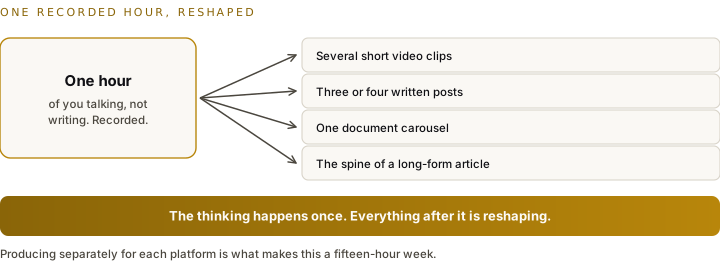
Being on several platforms is not what makes this exhausting. Producing separately for each one is. The workflow that survives starts with a single hour of raw material, usually you talking rather than writing, and treats every published piece as a derivative of that hour rather than a new act of creation. One recorded conversation reliably yields several short video clips, three or four written posts, one document carousel and the spine of a long-form article. The thinking happens once; everything after it is reshaping. That is the entire difference between a fifteen-hour week and a two-hour week, and it is the workflow we run for clients where they give us the hour and we do the rest.
- The exhaustion comes from producing per platform, not from the number of platforms.
- Talk first, write second. People are more specific out loud than on a page.
- One hour yields roughly a week of short video, posts, a carousel and a long-form spine.
- Reshaping is not repeating. Each surface needs a different cut, not a copy-paste.
Start by talking, not writing
Sit down with a recorder and answer one question about your work for forty minutes. Not a script, not bullet points. A question you would answer properly if a smart peer asked it over coffee.
This is the step people skip and it is the one that matters. Writing invites you to be careful, and careful is the enemy here. Talking produces the specifics, the asides, the actual example from three years ago, the bit where you say what you really think. Those are precisely the parts that make content memorable, and they almost never survive a blank page.
It is also faster. Forty minutes of talking produces more usable raw material than four hours of trying to write.
What one hour actually yields
A single recorded conversation, worked through properly, reliably produces this much.
| Output | Roughly how many | Where it comes from |
|---|---|---|
| Short video clips | 3 to 5 | The moments where you said something specific |
| Written posts | 3 to 4 | Each distinct argument, written out properly |
| Document carousel | 1 | A list or framework you described in passing |
| Long-form article | 1 spine | The through-line, expanded with what you cut |
| Podcast talking points | Several | Whatever you found yourself repeating |
Which is a week of publishing across several surfaces from one sitting. The constraint was never the ideas; it was treating each post as a separate creative act.
Reshaping, not reposting
The mistake at this stage is pushing the same asset everywhere. Each surface rewards a different shape, and the same idea has to be cut differently for each.
| Surface | What it wants | What fails there |
|---|---|---|
| LinkedIn text | A position stated plainly, then the reasoning | Links pushing people off the platform |
| Short video | One idea, said fast, in your own face and voice | A monologue that takes 30 seconds to get going |
| Carousel | A structure: steps, comparisons, a checklist | Prose broken across slides |
| Long-form | The full argument with the caveats included | A padded version of the post |
Same thinking, four different objects. It takes far less time than it sounds once the raw material exists, because you are editing rather than inventing.
The order that saves the most time
Record, then transcribe, then mark the good bits, then cut. In that order.
The temptation is to start editing video first because it feels like the real work. It is the slowest possible entry point. Read the transcript, mark the six moments worth using, and only then open an editor. You will cut a fraction of the footage and you will not sit through the whole recording three times.
One hour recorded, one hour marking and writing, one hour producing. Three hours for a week of output across several platforms, done yourself. That is the realistic floor, and it is roughly a fifth of what people spend doing it the disorganized way.
Why reshaping beats reposting, in numbers
The argument above is that each surface wants a different shape. The format data supports it, and it also tells you which shape to prioritize.
Published research
| Finding | Figure | Source |
|---|---|---|
| Native document (carousel) engagement rate | 7.00% | Socialinsider 2026 LinkedIn Benchmarks |
| Multi-image posts | 6.45% | Socialinsider 2026 LinkedIn Benchmarks |
| Video | 6.00% | Socialinsider 2026 LinkedIn Benchmarks |
| Text-only | 3.95% | Socialinsider 2026 LinkedIn Benchmarks |
| Shares generated by native documents versus video or image posts | 2.5x | Benchmark analysis, 2026 |
Figures as reported from the published benchmark studies. Engagement rates in this area vary substantially between studies depending on sample and how engagement is calculated, so treat the ordering as more reliable than the absolute numbers.
Which is a direct instruction for the workflow on this page. If one recorded hour is producing posts, clips and a carousel, the carousel is the piece most worth the extra twenty minutes. It is also the most reusable, because frameworks and checklists get saved and returned to in a way a text post does not.
Questions people actually ask
How do I post on multiple platforms without it taking all week?
Produce once and reshape. Record one conversation, pull the transcript, mark the strong moments, then cut them into video, posts, a carousel and a long-form spine. The thinking happens once; everything after is editing.
Why record instead of writing?
Because people are more specific out loud. Writing invites care and care produces the safe, forgettable version. Talking produces the examples and asides that make content worth reading.
Can I just post the same thing everywhere?
You can and it underperforms. Each surface rewards a different shape, so the same idea needs a different cut. Reposting identical assets is the most common reason multi-platform effort produces little.
How long does this realistically take?
About three hours a week doing it yourself: one recording, one marking and writing, one producing. That is the floor once the workflow exists, and considerably less than producing per platform.
References
- Written from the production workflow we run for clients.
How this was made: written from the workflow we run for clients, drafted with AI assistance, then reviewed and approved by the named author before publication. Our editorial standards.
This is the workflow, minus us. If three hours a week is still three hours you do not have, that is the gap we fill.
An hour of voice notes, a week of video →Related reading
Or send the hour and skip the other two
You record; we do the marking, scripting, production and distribution. Everything comes back for your approval.
Book a 30 minute call